
Academic Institutions
We enable educational institutions to build identities that are unmistakably their own while turning AI disruption, accelerating change, and uncertainty into opportunities for growth.
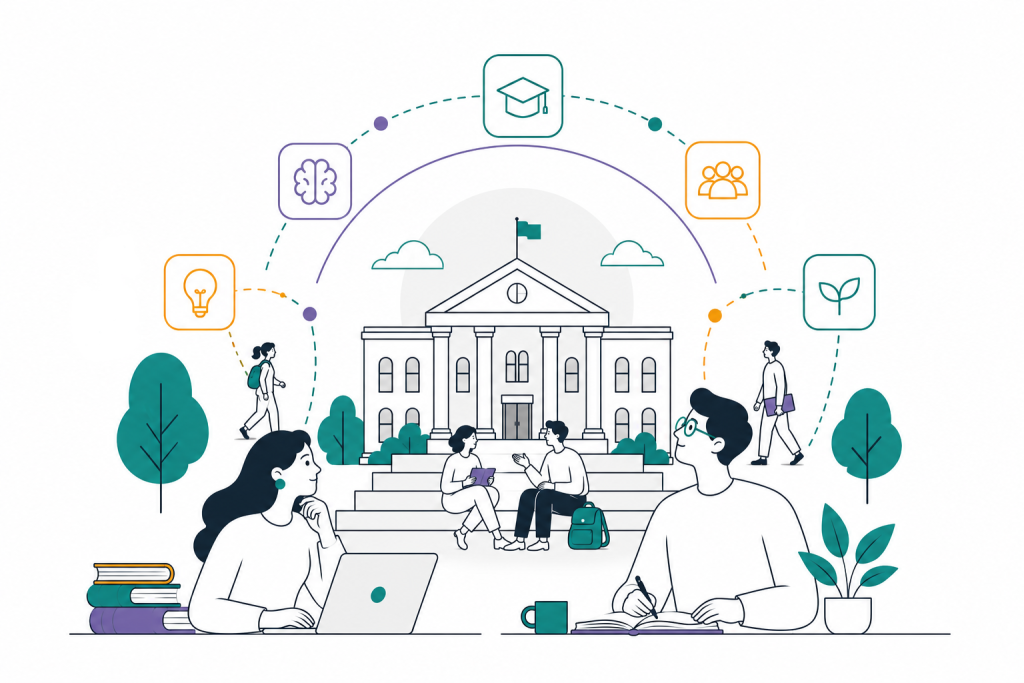
Through research-led curriculum innovation, faculty capability building, and student development, we embed enduring meta-skills that matter most in an age of AI: analytical thinking, creativity, adaptability, ethical judgement, systems thinking, and lifelong learning.
As AI transforms how knowledge is created and applied, institutions must prepare graduates not only for today’s professions, but for emerging opportunities, technologies, and ways of working. We help schools and universities build anti-fragile capabilities that turn technological disruption into an advantage, empowering learners, educators, and institutions to shape the future rather than react to it.
In doing so, we enable your institutions to become places that:
- Look to the future with vision, not anxiety
- Engage with AI confidently, critically, and responsibly rather than reactively.
- Prepare students for a transitioning world by combining academic rigour with real-world application
- Build on existing faculty and institutional strengths and compound them over time.
- Transform uncertainty and disruption into opportunities for growth, innovation, and leadership.
Curriculum & Pedagogy
We design coherent, future-facing curriculum ecosystems that prepare learners for a world shaped by AI, complexity, and continuous change. By embedding meta-skills, interdisciplinary learning and responsible AI integration,we align curriculum with emerging workforce needs and educational futures. Our approach ensures that curriculum, assessment, and learning experiences work together to develop capabilities that remain valuable even as technologies evolve.
The result is a competency-based, resilient and future-ready learning ecosystem that strengthens institutional relevance, graduate outcomes, and long-term impact.
Student Development
We design intentional student development pathways that cultivate adaptive, discerning and future-ready learners. By embedding critical thinking, creative capacity, integration and responsible AI judgement, into applied learning.
The outcome is confident graduates who can articulate their strengths, navigate global and industry landscapes, and transition seamlessly into higher study, work and leadership.
Faculty Upskilling
Faculty today are not only teachers, they are mentors, educators, collaborators, and institutional ambassadors. We equip educators to navigate these expanding roles with clarity, confidence and strategic intent.
We support educators in navigating technological change with confidence, helping them integrate AI meaningfully into teaching, assessment, feedback, and curriculum design while preserving the distinctly human dimensions of learning.
Through active learning, game-based pedagogy, and research-informed innovation, we help faculty evolve their approach from content delivery towards designing transformative learning experiences.
The result is educators who can confidently leverage emerging technologies, foster deeper student engagement, and lead institutional innovation with judgement, creativity, and purpose.
How we work
An enterprise under market pressure and an academic institution navigating generational turnover are carrying different problems. The method holds for both.
Research and strategy comes first.
We map how decisions actually get made inside an organisation, which is rarely the same as how the org chart says they get made.
Design follows from what that research finds.
We build the structure to leverage what already exists and what the organisation can run.
We co-design it with the people who will use it.
A curriculum shaped without the faculty who teach it gets taught reluctantly. A governance structure shaped without the managers who operate it gets worked around within a year. Building it with them means it already belongs to them by the time it is finished.
We embed to run the first live version.
A system on paper tells you nothing about how it holds under real pressure, so we stay inside the organisation while it runs, and rebuild against what actually happens.
Then we train the people who will own it.
We stay until they can run the system, adjust it under pressure, and be able to teach it to whoever comes after them.
An engagement ends when the capability we built is running under someone else's name.
An enterprise under market pressure and an academic institution navigating generational turnover are carrying different problems. The method holds for both: understand the system before touching it, build it with the people who live inside it, stay long enough to make sure it survives your absence.